Original 2026 research for GCC audiences comparing cryptocurrency payments at 10 online casinos, including Bitcoin, USDT, deposits and withdrawal limits.
Bitcoin, Litecoin and Dogecoin appeared in eight of the ten casino payment records examined by The Arabic Casino, making them the most frequently observed cryptocurrencies in our 2026 research. However, acceptance was only part of the story. When we examined the actual deposit and withdrawal conditions, we found that USDT withdrawals could require four times the minimum deposit amount, while Dogecoin showed the opposite pattern, with a much smaller minimum withdrawal than deposit.
Our research examined cryptocurrency payment information from ten international casino operators: Lucky Dreams, JustCasino, Betfinal, AmunRa Casino, EmirBet, Let’s Lucky, LuckyOnes, YYY Casino, VIPArab Club and Casinia. The study was developed for audiences researching international casino payment methods from the Gulf Cooperation Council (GCC), including the UAE, Saudi Arabia, Kuwait, Qatar, Bahrain and Oman.
We analysed cryptocurrency availability, minimum deposits, withdrawal thresholds, maximum transaction amounts, advertised fees and blockchain-network information. We also investigated why several casino brands publish nearly identical cryptocurrency payment conditions and how different operators express their limits in cryptocurrency units or US dollars.
The resulting comparison reveals more than which casinos display Bitcoin or USDT logos. It shows how transaction conditions can differ between cryptocurrencies, how similar limits can appear across separate brands, and why the payment information visible before a transaction may not tell the whole story.
The research was conducted using payment information collected in November 2026 from ten selected international online casino operators. Sources included cashier screenshots, published cryptocurrency deposit and withdrawal tables, operator terms and conditions, and third-party payment listings where detailed cashier information was unavailable. For each cryptocurrency, we recorded the information available about deposits, withdrawals, transaction minimums and maximums, advertised fees and processing arrangements.
The operators were selected because they were relevant to our research into international cryptocurrency casino payments for GCC audiences, not through a random sample of the wider gambling industry. The findings therefore describe these ten operators rather than all cryptocurrency casinos worldwide. They also do not establish that every sampled operator is available or authorised throughout the six GCC countries.
The level of available payment information differed between operators. Lucky Dreams, JustCasino, Betfinal, Let’s Lucky and LuckyOnes supplied detailed cryptocurrency payment tables, while AmunRa Casino and Casinia displayed specific deposit and withdrawal ranges for selected digital assets. Information for EmirBet came from a Casino Guru payment listing, while YYY Casino and VIPArab Club had more limited cryptocurrency-specific information in the material collected.
We preserved these differences when analysing the data. A cryptocurrency shown in a payment-method list was recorded as an observed asset, but its presence was not automatically treated as confirmation of both deposit and withdrawal availability. Likewise, network details that could not be established from the screenshots were classified as unverified rather than unavailable. The research did not involve live transactions, so the conclusions concern published payment arrangements rather than independently measured transfer costs or processing speeds.
Bitcoin, Dogecoin and Litecoin were the most frequently observed cryptocurrencies in our ten-operator comparison, each appearing in eight payment records. Ethereum, Cardano, TRON and USDT followed with seven appearances each, while Bitcoin Cash and XRP appeared in six records. BNB was identified in five operator payment displays, with several other assets appearing less frequently.
The results are particularly interesting for Litecoin and Dogecoin. Although Bitcoin is among the most recognisable cryptocurrency payment methods, LTC and DOGE matched its observed frequency within this sample. This suggests that the cryptocurrency selections displayed by these operators extend well beyond BTC and Ethereum, with alternative digital assets occupying a visible position in their payment offerings.
USDT also featured prominently, appearing in seven of the ten records. Unlike Bitcoin or Litecoin, Tether is a stablecoin intended to track the value of the US dollar, making its payment characteristics different from cryptocurrencies whose market prices fluctuate more freely. However, its presence in a casino payment menu does not establish which blockchain networks are supported, an issue we examine later in the research.
These figures measure how often cryptocurrencies appeared in the collected payment information. They do not represent market share, actual payment volumes or player preferences, and a general payment-method listing does not necessarily establish that an asset is supported for both incoming and outgoing transfers.
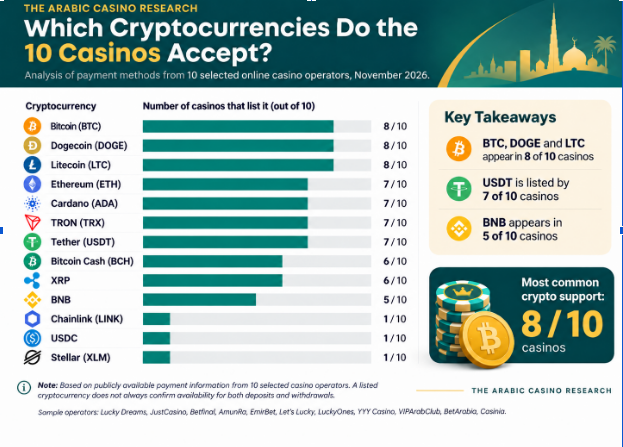
Figure 1. Cryptocurrency assets observed across ten selected international online casino operators. The figures measure documented payment-method listings rather than actual transaction volumes.
The results provide a useful starting point for understanding cryptocurrency availability, but acceptance alone does not establish whether an asset is convenient for a particular transaction. Two casinos can advertise the same cryptocurrency while applying different deposit and withdrawal thresholds, making the payment conditions behind the logo just as important as the currency itself.
Minimum deposit requirements determine the smallest amount an operator lists for funding an account with a particular cryptocurrency. These limits can vary by coin and casino, and they may be expressed either in cryptocurrency units or in a conventional currency such as the US dollar. Our research identified recurring minimums among several operators, alongside a different approach used by AmunRa Casino and Casinia.
Lucky Dreams, JustCasino, Betfinal, Let’s Lucky and LuckyOnes displayed closely matching minimum deposit amounts for several cryptocurrencies. Bitcoin deposits started at 0.0001 BTC, while the corresponding Ethereum minimum was 0.002 ETH and Litecoin started at 0.01 LTC. USDT deposits began at 5 USDT, Bitcoin Cash at 0.001 BCH and Dogecoin at 1 DOGE. TRON and Cardano also appeared in the detailed payment records, with observed minimums of 10 TRX and 2 ADA respectively.
These figures are useful because they establish the published entry thresholds for each asset, but they should not be interpreted as a ranking of the cheapest cryptocurrencies for making a casino deposit. The monetary value of 0.0001 BTC is not directly comparable with 0.01 LTC or 1 DOGE without converting the amounts at a defined exchange rate. Wallet and exchange charges can also affect how much cryptocurrency must be sent to deliver the required amount.
AmunRa Casino and Casinia took a different approach in the selected cashier screenshots. Instead of expressing every cryptocurrency threshold in native coin units, both operators displayed dollar-denominated deposit ranges for Litecoin, TRON, Dogecoin and Cardano. For these assets, the published deposit minimum was $15, while the maximum was $5,000.
This distinction changes the comparison. A casino requiring 0.01 LTC establishes a fixed Litecoin quantity, whereas a $15 Litecoin deposit is expressed in conventional currency terms. The amount of LTC needed to satisfy the latter requirement depends on the conversion applied by the payment system at the time of the transaction.
It would therefore be misleading to compare a $15 Litecoin minimum with 0.01 LTC simply by placing the two figures alongside each other. Their relative monetary values depend on market prices and the operator’s conversion process. Our analysis preserves the original payment units rather than converting them using an assumed exchange rate.
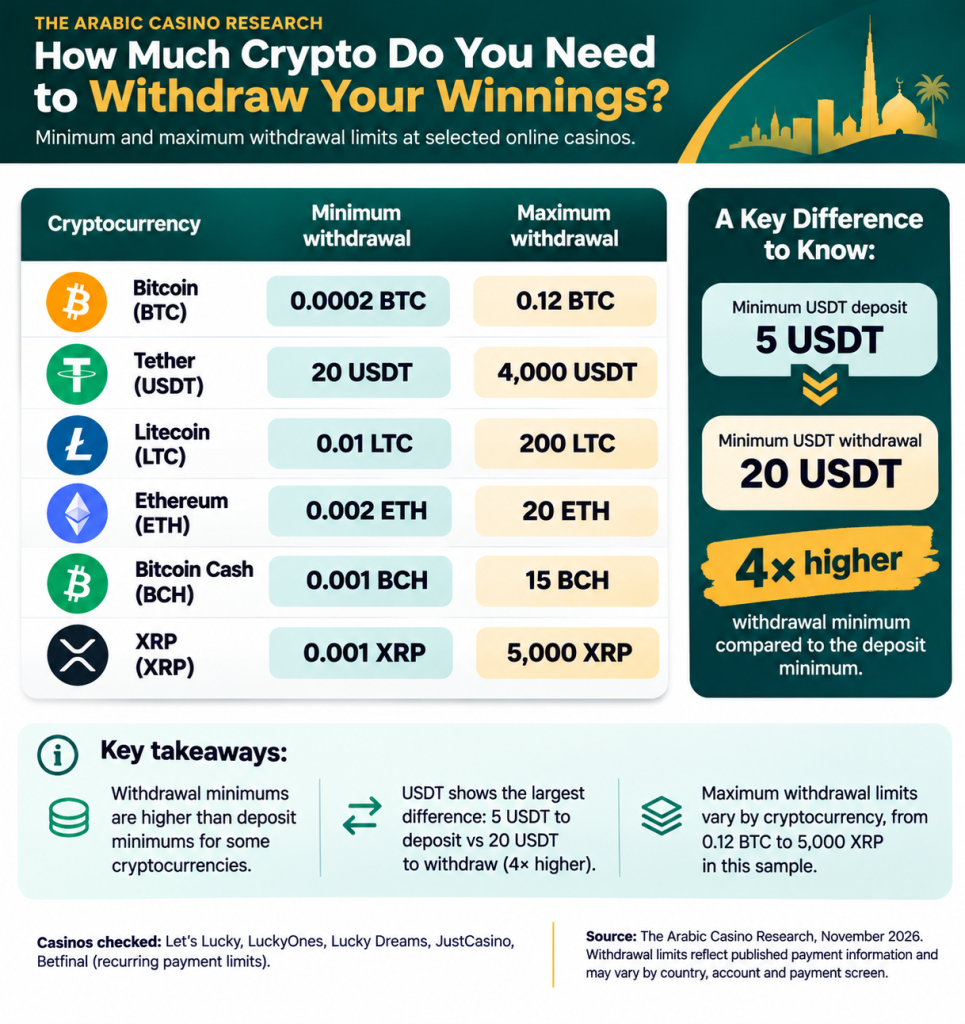
Figure 2. Selected cryptocurrency deposit minimums observed in the research. Asset-denominated thresholds and USD-denominated requirements are presented separately because they use different measurement bases.
The deposit figures demonstrate how the minimum amount needed to fund an account can depend on both the cryptocurrency and the operator’s pricing method. However, the lowest permitted deposit does not always match the minimum amount that can later be withdrawn. That distinction produced one of the clearest numerical findings of the entire study.
The difference between depositing and withdrawing cryptocurrency was particularly noticeable among operators publishing detailed payment tables. Some assets had identical minimums for both transaction types, while others required substantially larger amounts for withdrawals. The relationship was not consistent across cryptocurrencies, even when the payment methods appeared within the same casino.
At Let’s Lucky and LuckyOnes, Bitcoin deposits started at 0.0001 BTC, but withdrawals required at least 0.0002 BTC. This made the minimum withdrawal twice the minimum deposit. For USDT, the deposit minimum was 5 USDT and the withdrawal minimum was 20 USDT, producing a fourfold difference. Similar BTC and USDT thresholds appeared in the detailed payment information for Lucky Dreams, JustCasino and Betfinal.
Dogecoin showed the opposite relationship. At Let’s Lucky and LuckyOnes, the minimum deposit was 1 DOGE, while the published minimum withdrawal was just 0.01 DOGE. That makes the withdrawal threshold 100 times smaller than the deposit threshold in DOGE units. Litecoin and TRON, meanwhile, showed matching deposit and withdrawal minimums of 0.01 LTC and 10 TRX respectively. Ethereum also had matching minimums of 0.002 ETH, while Bitcoin Cash used 0.001 BCH for both transaction types.
These differences highlight why minimum deposit figures cannot be used as a substitute for withdrawal conditions. A payment method may allow a relatively small incoming transfer while requiring a larger amount before the same cryptocurrency can be withdrawn. Equally, a very low published withdrawal minimum does not guarantee that a transaction of that exact size will be practical through every wallet or exchange.
The Dogecoin result is especially unusual because the published minimum withdrawal is substantially smaller than the deposit minimum. Although the arithmetic difference is clear, our research did not test whether a 0.01 DOGE withdrawal would be processed under every account configuration. The finding should therefore be understood as a comparison of advertised cashier thresholds rather than a guarantee of successful transfer execution.
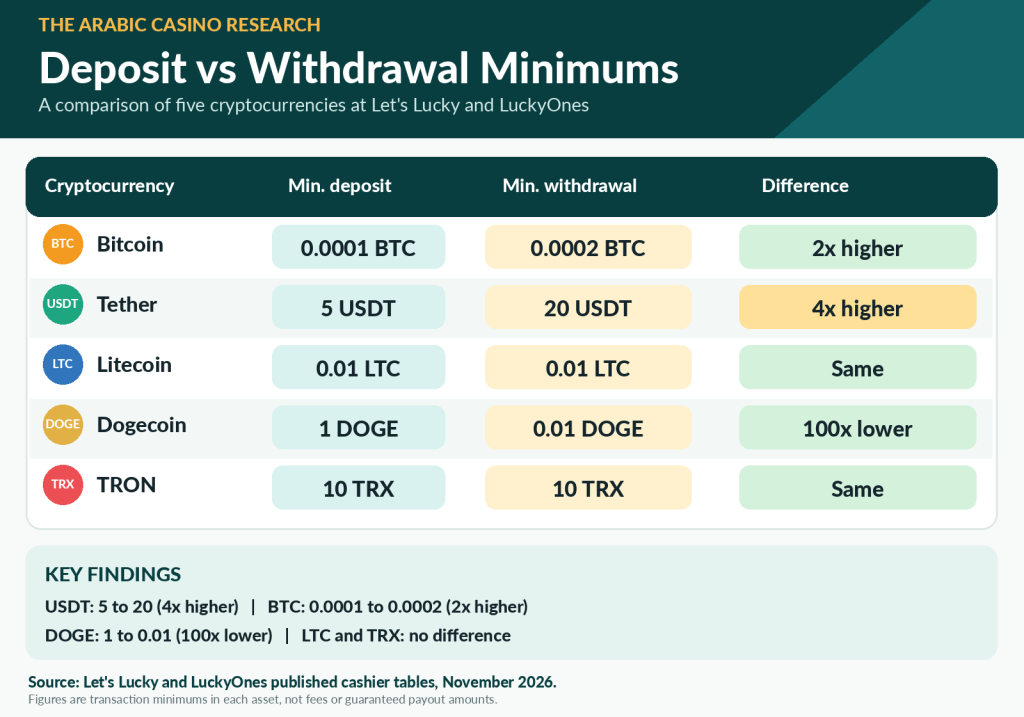
Figure 3. Minimum deposit and withdrawal thresholds for selected cryptocurrencies at Let’s Lucky and LuckyOnes. USDT withdrawals require four times the minimum deposit, BTC withdrawals require twice the minimum deposit, and DOGE withdrawals have a minimum 100 times smaller than deposits.
The differences demonstrate that cryptocurrency payment rules are asset-specific rather than necessarily uniform across a casino’s payment selection. They also provide a reason to examine the actual numbers behind individual payment methods rather than treating all supported cryptocurrencies as interchangeable.
Another finding emerged when comparing Lucky Dreams, JustCasino, Betfinal, Let’s Lucky and LuckyOnes. Across several cryptocurrencies, these five operators displayed closely matching deposit and withdrawal minimums, despite operating under different casino brands. The similarities extended beyond Bitcoin, appearing in the reported thresholds for USDT, Litecoin, Ethereum and Bitcoin Cash.
For example, the recurring Bitcoin minimums were 0.0001 BTC for deposits and 0.0002 BTC for withdrawals. USDT followed the same pattern across the comparison group, with deposits starting at 5 USDT and withdrawals at 20 USDT. Litecoin minimums were 0.01 LTC for both directions, while Ethereum used 0.002 ETH and Bitcoin Cash used 0.001 BCH.
The repeated figures are noteworthy because cryptocurrency payment conditions might be expected to vary more noticeably across unrelated brands. One possible explanation is that similar payment-processing systems or service arrangements influence the limits displayed to users. Another is that the operators have independently adopted comparable transaction requirements. The available evidence does not establish shared ownership or identify a particular common payment provider.
What can be established is that several brands in our sample use nearly identical published thresholds for multiple cryptocurrencies. This means a comparison involving numerous casino websites may still capture a relatively small number of distinct payment configurations. The number of brands examined does not necessarily correspond to the diversity of payment arrangements represented.
The finding is also relevant when interpreting cryptocurrency casino comparisons more broadly. If several operators share the same published limits, repeating those numbers under different brand names adds little analytical value unless other differences can be demonstrated. Identifying these similarities allows the research to focus on genuine variation rather than treating every repeated payment condition as a separate discovery.
Minimum withdrawal amounts establish the smallest cryptocurrency transfer permitted by a casino’s published rules, but maximum limits determine the upper threshold for an individual transaction. Our research found that these maximums varied considerably between cryptocurrencies, with the detailed payment tables listing limits in native digital-asset units rather than applying a single monetary maximum across all methods.
Among the operators with matching cryptocurrency payment tables, Bitcoin withdrawals had a reported maximum of 0.12 BTC per transaction, while Ethereum withdrawals reached 20 ETH. Litecoin had a maximum of 200 LTC, Bitcoin Cash reached 15 BCH and USDT had a listed maximum of 4,000 USDT. The figures for several other assets were numerically much larger, including 5,000 XRP, 225,000 TRX, 460,000 ADA and 20 million DOGE.
The very different numerical values reflect the fact that cryptocurrencies have different unit prices. A maximum of 20 million DOGE cannot be compared directly with 0.12 BTC simply because one number is much larger. A meaningful financial comparison would require converting both amounts into the same currency at a specific point in time, while preserving the fact that the original cashier limits were expressed in cryptocurrency units.
These maximums also need to be distinguished from wider account restrictions. A casino may permit an individual cryptocurrency withdrawal up to a stated maximum while separately limiting how much an account can withdraw over a day, week or month. Account verification requirements and membership conditions can introduce additional restrictions that are not represented by the cryptocurrency-specific transaction maximum.
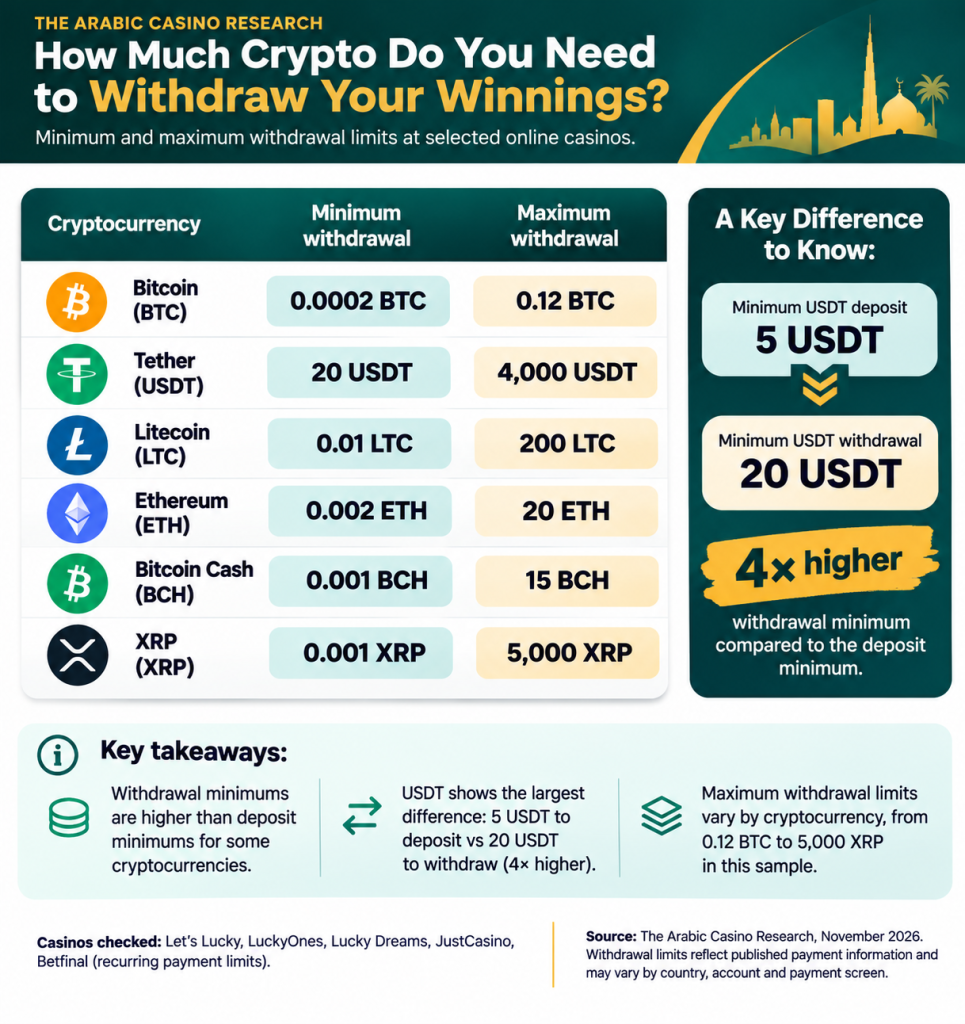
Figure 4. Selected minimum and maximum cryptocurrency withdrawal limits from operators publishing detailed asset-specific transaction thresholds. Limits are shown in their original cryptocurrency units rather than converted into a common currency.
The payment information collected for VIPArab Club illustrates how general account-level withdrawal allowances can differ from individual cryptocurrency transaction maximums. Its published withdrawal terms included limits determined by VIP membership status, with higher account levels receiving larger daily and monthly allowances. These are account-level conditions rather than confirmed maximums for a specific cryptocurrency transfer.
EmirBet’s Casino Guru listing reported a weekly withdrawal limit of €5,000, but the available material did not establish whether this applied identically to every cryptocurrency payment method. It would therefore be misleading to compare that weekly figure directly with a maximum of 0.12 BTC or 4,000 USDT per transaction.
The distinction matters because a maximum per transaction and a maximum per week do not measure the same restriction. An operator could permit several transactions within a broader withdrawal allowance, while another could apply a smaller total limit regardless of the number of requests. Our study keeps these conditions separate instead of combining them into a single ranking of casinos by withdrawal size.
Tether appeared in seven of the ten operator records, making it one of the frequently observed cryptocurrencies in the study. However, the payment screenshots and listings collected did not establish the complete USDT blockchain-network options supported by the sampled casinos. This creates an important distinction between knowing that an operator lists USDT and knowing which transfer route can actually be used.
USDT exists on several blockchains, including Ethereum and Tron. Exchanges and wallets may also support transfers through other compatible networks, depending on the service. A payment interface that displays USDT without specifying a network does not establish whether ERC20, TRC20 or another route is accepted by the receiving system.
This can affect users moving cryptocurrency from an external exchange. A sending service may offer several networks for withdrawing USDT, while the casino’s payment provider may support only selected options. Choosing a network that is incompatible with the receiving instructions can prevent the transfer from being credited as intended, making network confirmation a separate requirement from selecting the correct cryptocurrency.
The absence of network information in our collected evidence does not prove that casinos fail to provide these details during actual transactions. Some systems reveal deposit addresses, supported networks or other instructions only after an account is accessed or a payment method is selected. Our findings therefore classify network compatibility as unverified rather than unsupported.
The broader issue is that cryptocurrency acceptance lists provide only part of the information needed to understand a transfer. A clear payment process must identify both the asset and the receiving network, particularly for stablecoins that can circulate across multiple blockchains.
Several operators with detailed payment tables displayed cryptocurrency deposit and withdrawal fees as free. This indicates that the casino did not list a separate charge for those methods in the supplied cashier information, but it does not establish that every part of the transfer is free of cost.
A user sending cryptocurrency from a personal wallet may need to pay a blockchain network fee. Someone transferring an asset from a cryptocurrency exchange may face an additional withdrawal charge determined by that platform. These expenses are separate from the casino’s advertised cashier fees and can affect the amount ultimately delivered to the receiving account.
The same distinction applies after receiving a cryptocurrency withdrawal. Converting BTC, LTC, DOGE or another digital asset into a conventional currency may involve exchange spreads, trading charges or additional network transfers. Those costs are not necessarily disclosed in the casino payment table because they occur through external services.
Our research did not include controlled live transactions across the same wallets, exchanges and blockchains, so it cannot establish which operator provides the lowest total transfer cost. The supported finding is narrower: several casinos advertised free processing on their side, while the complete cost of moving cryptocurrency depended on factors outside the available payment records.
For audiences in the UAE, Saudi Arabia, Kuwait, Qatar, Bahrain and Oman, the research highlights the importance of looking beyond the list of accepted cryptocurrencies when comparing international casino payment methods. The amount required for a deposit or withdrawal, the blockchain used for the transfer and the currency in which the limit is expressed can each influence the practical payment process.
The contrast between dollar-denominated limits and fixed cryptocurrency amounts is particularly relevant when comparing values in AED, SAR, KWD, QAR, BHD or OMR. A casino displaying a $15 deposit minimum establishes a conventional-currency reference, while an operator requiring 0.01 LTC uses a fixed cryptocurrency quantity. As the market price of Litecoin changes, the conventional-currency value of that fixed amount changes with it.
The distinction also applies to withdrawals. Someone receiving BTC or another cryptocurrency may find that its local-currency value differs between the time a withdrawal is requested and the time the funds are converted. External exchange rates and transaction costs can affect the final amount received, making published minimums and maximums only one part of the overall payment arrangement.
Network compatibility adds another consideration. A wallet or exchange may allow USDT transfers through several blockchains, but that does not establish that the receiving casino accepts every available route. The asset, network and receiving instructions must be considered together, regardless of the country from which the transaction is initiated.
These findings should not be interpreted as a country-by-country assessment of gambling availability or cryptocurrency adoption across the GCC. The study examines ten selected international casino operators rather than measuring casino payment preferences in individual Gulf countries. Its relevance lies in identifying payment conditions that audiences researching international cryptocurrency services need to understand.
Readers interested in individual digital assets can explore our crypto casino guide for more information about cryptocurrency payment methods, while our USDT casino resource examines Tether deposits and withdrawals in greater detail. Those guides complement this research by addressing individual payment options, whereas the present study focuses on patterns and differences observed across multiple operators.
Our comparison of ten international casino operators revealed that cryptocurrency payment conditions can differ considerably even when the same assets appear in multiple payment menus. Bitcoin, Dogecoin and Litecoin were the most frequently observed cryptocurrencies, but the more distinctive findings concerned deposit and withdrawal thresholds, maximum transaction sizes and the repeated payment conditions published by several casino brands.
USDT provided one of the clearest examples of differing transaction requirements, with minimum withdrawals four times higher than deposits in the recurring payment tables. Bitcoin withdrawals required twice the minimum deposit amount, while Dogecoin showed the opposite relationship at Let’s Lucky and LuckyOnes, where the listed withdrawal minimum was 100 times smaller than the deposit minimum. These differences demonstrate why an accepted cryptocurrency cannot be evaluated solely by its minimum deposit.
The research also revealed nearly identical cryptocurrency payment thresholds across five casino brands, alongside a different system of USD-denominated limits at AmunRa Casino and Casinia. These patterns show that the way operators structure and present payments can be as important as the number of currencies they offer. They also highlight the need to distinguish transaction-specific maximums from wider account withdrawal restrictions.
Finally, although USDT appeared in seven operator records, the collected evidence did not establish complete network compatibility for Tether transfers. This leaves an important distinction between observing cryptocurrency acceptance and verifying the instructions required to complete an actual payment.
Taken together, the findings show that a meaningful cryptocurrency casino comparison requires more than counting supported digital assets. Deposit and withdrawal minimums, transaction maximums, original currency denominations and network compatibility all contribute to a fuller understanding of the payment conditions published by international operators.